
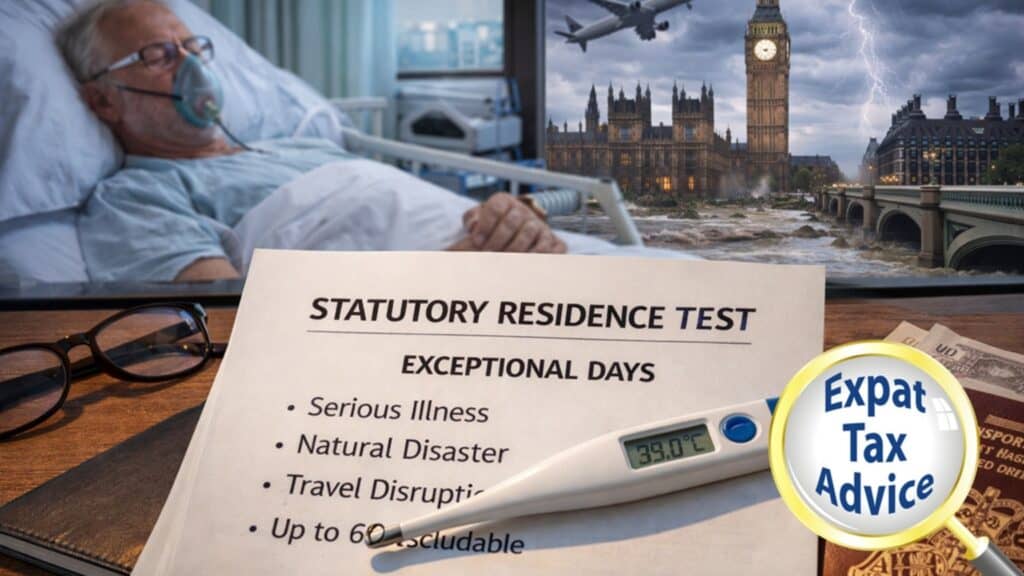
Within the UK’s Statutory Residence Test (SRT), the concept of an “exceptional day” allows certain days spent in the UK to be disregarded when counting days for residence purposes. This provision is tightly defined and frequently scrutinised, making it essential to understand both its scope and its limits.
What Is an Exceptional Day?
An exceptional day arises where:
- An individual is present in the UK at midnight, and
- They are prevented from leaving the UK due to circumstances beyond their control, and
- They intend to leave as soon as those circumstances permit
Where these conditions are met:
- The day does not count as a UK day for SRT purposes
- A maximum of 60 such days per tax year may be disregarded
This is a narrowly targeted relief – not a general flexibility rule.
What Qualifies as “Exceptional Circumstances”?
The legislation and HMRC guidance point to situations that are unexpected, unavoidable, and external to the individual. Common examples include:
Serious Illness or Injury
- The individual is medically unfit to travel
- Hospitalisation or doctor-advised immobility
- Includes situations affecting close family members where presence is necessary
Travel Disruption
- Cancellation of flights due to extreme weather
- Airspace closures or widespread transport strikes
- Border closures or government-imposed travel bans
National or International Emergencies
- Natural disasters (e.g. volcanic eruptions, floods)
- Civil unrest or war
- Public health emergencies (as seen during global pandemics)
In each case, the key test is whether the individual is effectively “trapped” in the UK.
The Intention Requirement
Even where circumstances are exceptional:
- The individual must demonstrate a clear intention to leave the UK
- Once the constraint is lifted, departure should occur as soon as reasonably practicable
Delays for convenience or personal preference will undermine the claim.
The 60-Day Cap
The relief is limited:
- Only up to 60 days per tax year can be treated as exceptional
- Any additional days beyond this limit must be counted
This cap ensures the rule remains a safeguard—not a planning tool.
What Does Not Count as an Exceptional Day?
A frequent source of error is assuming that inconvenience equals exceptionality. It does not. The following are specifically excluded:
Personal Choice or Preference
- Choosing to remain in the UK for comfort or convenience
- Extending a stay to avoid travel disruption elsewhere
Foreseeable or Manageable Events
- Minor travel delays where alternative routes exist
- Routine business commitments
- Pre-planned medical treatment
Family or Lifestyle Decisions
- Staying longer for family visits or personal matters
- School holidays or childcare considerations
Administrative or Financial Issues
- Visa delays
- Awaiting documentation
- Cost considerations affecting travel timing
In all such cases, the individual is not prevented from leaving—they are choosing not to.
Burden of Proof
The responsibility lies with the taxpayer to demonstrate:
- The nature of the exceptional circumstance
- Why it prevented departure
- Evidence of intent to leave promptly
Supporting evidence may include:
- Medical certificates
- Airline cancellation records
- Government travel advisories
HMRC will assess claims critically, particularly where patterns suggest borderline residence.
Practical Implications
Exceptional days can be decisive in close SRT cases, but they are:
- Fact-specific
- Strictly interpreted
- Limited in number
Individuals with significant UK ties or day counts near key thresholds should not rely on this provision without robust evidence.
Conclusion
The exceptional days rule exists to ensure fairness where individuals are genuinely unable to leave the UK. However, it is not a discretionary relief for inconvenience or
personal choice. Its application depends on necessity, not preference – and on evidence, not assertion.
Understanding this distinction is essential to applying the SRT correctly and avoiding unintended UK residence. If we can assist you with any issues relating to non-resident taxation, contact us on info@expat-tax-advice.co.uk
Frequently Asked Questions
1. What is an exceptional day in the Statutory Residence Test?
An exceptional day is a day spent in the UK that can be ignored for Statutory Residence Test purposes where you were prevented from leaving due to circumstances beyond your control, and you intended to leave as soon as those circumstances allowed.
2. How many exceptional days can you claim in a tax year?
You can disregard up to 60 exceptional days in a single tax year. If you spend more than 60 qualifying days in the UK, any additional days above that limit will still count towards your UK day count.
3. What counts as exceptional circumstances for SRT purposes?
Exceptional circumstances can include serious illness, medical advice not to travel, flight cancellations caused by extreme weather, border closures, war, civil unrest, or public health emergencies. The key point is that you must have been genuinely prevented from leaving the UK.
4. Do travel delays automatically count as exceptional days?
No. Not every delay qualifies. Minor disruption, inconvenience, cost concerns, or situations where alternative routes were available will not usually count as exceptional circumstances. HMRC looks closely at whether you were truly unable to leave.
5. What evidence do you need to support an exceptional days claim?
You should keep clear records showing what prevented your departure and that you intended to leave as soon as possible. Useful evidence may include medical certificates, cancelled flight confirmations, travel rebooking records, and official travel restriction notices.