
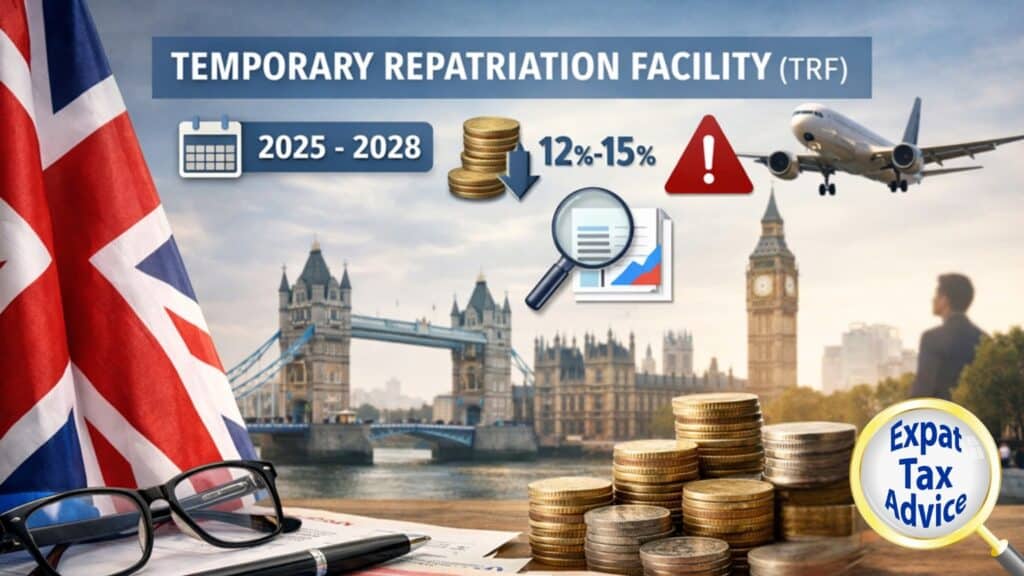
The UK’s Temporary Repatriation Facility (TRF) is a key transitional tax measure introduced as part of the sweeping reforms to the taxation of non-domiciled individuals (“non-doms”), effective from 6 April 2025. With the abolition of the remittance basis for most taxpayers, the TRF provides a limited-time opportunity for individuals with historic offshore income and gains to bring those funds into the UK at significantly reduced tax rates.
This article explains the technical framework of the TRF, its relevance to individuals returning to the UK after a period of non-residence, and the practical risks and pitfalls that must be carefully managed.
1. Background and Purpose of the TRF
Historically, non-domiciled individuals in the UK could elect to be taxed on the remittance basis, meaning foreign income and gains were only taxed if brought into the UK. However, from 6 April 2025, this regime has been abolished and replaced by a residence-based system.
The TRF was introduced as a transitional mechanism to deal with accumulated offshore funds generated under the old rules. Its core purpose is to incentivise taxpayers to “clean up” historic foreign income and gains by bringing them into the UK at a discounted tax rate.
The facility operates for a fixed three-year window:
- 2025/26
- 2026/27
- 2027/28
After this period, normal tax rates (up to 45%) apply to remittances.
Reduced tax rates
The most attractive aspect of the TRF is its preferential tax rates:
- 12% for designations made in 2025/26 and 2026/27
- 15% for designations made in 2027/28
This compares favourably to standard UK income tax or capital gains tax rates, which can reach 45%.
Scope of eligible funds
The TRF applies to as “qualifying overseas capital”, being:
- Foreign income and gains arising before 6 April 2025
- Amounts that were subject to the remittance basis
- Funds that remain unremitted or are remitted during the TRF period
Importantly, the TRF can also apply to:
- Certain trust distributions
- Funds with uncertain origin (subject to conditions)
Designation requirement
To use the TRF, taxpayers must make a designation election in their UK tax return, specifying the amount to which the TRF applies, and once designated:
- The amount is taxed at the TRF rate
- It is effectively “cleansed” and treated as capital
- It can be remitted to the UK without further UK tax
But importantly, the funds do not need to be physically remitted immediately to benefit from the reduced tax regime.
3. Eligibility Criteria
To access the TRF, an individual must meet three core conditions:
- Be UK tax resident in the relevant tax year
- Have been subject to the remittance basis in at least one prior year
- Hold qualifying overseas capital
Crucially, non-residents cannot use the TRF directly.
4. Use of TRF by Non-Residents Returning to the UK
Although non-residents cannot claim the TRF while abroad, the rules are particularly relevant for individuals planning to return to the UK.
Timing of return
A returning individual can access the TRF if:
- They become UK resident during the TRF window (i.e. before 6 April 2028)
- They previously used the remittance basis
If they return after the window closes, the opportunity is lost, and historic offshore funds may be taxed at full rates.
Treatment of historic funds
Returning individuals can designate:
- Foreign income and gains that arose before they left the UK
- Amounts accumulated offshore during periods when they were UK resident and using the remittance basis
Even funds remitted while temporarily non-resident may be caught and eligible for TRF treatment when the individual returns.
Strategic planning opportunity
For returning non-residents, the TRF offers a unique planning opportunity:
- “Cleanse” offshore accounts
- Repatriate wealth for UK investment
- Avoid future higher tax charges
However, this requires careful timing of residence status and remittances.
5. Advantages of the TRF
The TRF provides several strategic benefits:
- Low tax cost: The flat 12–15% rate is significantly lower than standard UK tax rates.
- Certainty and simplification: It allows taxpayers to convert complex mixed funds into clean capital, reducing future administrative burdens.
- Flexibility: Funds can be designated without immediate remittance, allowing liquidity planning.
- Trust planning opportunities: The TRF can apply to certain trust structures, offering a way to unlock previously trapped value
6. Risks and Problems: Despite its advantages, the TRF is not straightforward. Several risks and technical challenges arise.
i. Incorrect identification of qualifying funds
Only income and gains arising before 6 April 2025 qualify.
Misidentifying …
- Post-2025 income
- Clean capital
- Mixed funds
…. can result in incorrect tax treatment and potential penalties.
ii. Complexity of mixed funds
Many offshore accounts contain a mixture of:
- Income
- Gains
- Clean capital
Without accurate tracing, taxpayers risk:
- Overpaying tax (designating too much)
- Underpaying tax (incorrectly excluding taxable amounts)
iii. No credit for foreign tax
A key disadvantage is that foreign tax credits are not available against the TRF charge. This creates a risk of double taxation, particularly for individuals with exposure to other jurisdictions (particularly notable for US taxpayers).
iv. Irrevocable election
Once an amount is designated …
- The election cannot generally be reversed
- The tax becomes payable regardless of future plans
…this creates a risk if circumstances change (e.g. relocation again).
v. Interaction with other regimes
The TRF interacts with:
- Temporary non-residence rules
- Trust taxation rules
- Business Investment Relief
These interactions can produce unexpected outcomes, particularly where funds move across borders or structures.
vi. Timing risks for returning individuals
For non-residents planning to return…
- Returning too late (after April 2028) removes access entirely
- Returning too early may trigger UK taxation before planning is complete
…. creates a narrow planning window.
vii. Liquidity and cash-flow issues
Although funds need not be remitted immediately, the TRF tax charge must still be paid. This can create liquidity problems if:
- Funds are illiquid (e.g. investments, property)
- Exchange controls or legal restrictions apply
viii. Increased scrutiny and compliance risk
The TRF effectively acts as a voluntary disclosure mechanism.
HMRC is likely to scrutinise…
- Source of funds
- Accuracy of designations
- Historical compliance
… and errors could lead to penalties or investigations.
ix. Opportunity cost
Using the TRF may not always be optimal. For example:
- Some funds may never be remitted
- Future residence planning may avoid UK tax entirely
Therefore, electing into the TRF prematurely can create unnecessary tax liabilities.
7. Practical Considerations
Taxpayers considering the TRF, especially returning non-residents, should…
- Conduct a full forensic review of offshore funds
- Segregate accounts where possible
- Model different scenarios (TRF vs. non-TRF)
- Consider timing of UK residence
- Seek specialist advice
.. as the rules are highly technical, and even small errors can be costly.
Conclusion
The Temporary Repatriation Facility represents a significant, time-limited opportunity within the UK’s post-2025 non-dom regime. It allows individuals—particularly those returning to the UK—to bring historic offshore income and gains into the UK at preferential tax rates, effectively resetting their tax position.
However, the TRF is not a simple tax amnesty. It is a complex regime with strict eligibility criteria, intricate technical rules, and significant risks. For returning non-residents, success depends heavily on timing, accurate fund analysis, and careful planning, which is why you would engage with us by emailing info@expat-tax-advice.co.uk, and let us and our specialist IFA friends that have the international knowledge and skills help you.
Used correctly, the TRF can unlock offshore wealth efficiently. Used incorrectly, it can lead to unnecessary tax charges, compliance issues, and lost opportunities.