
Quick answer
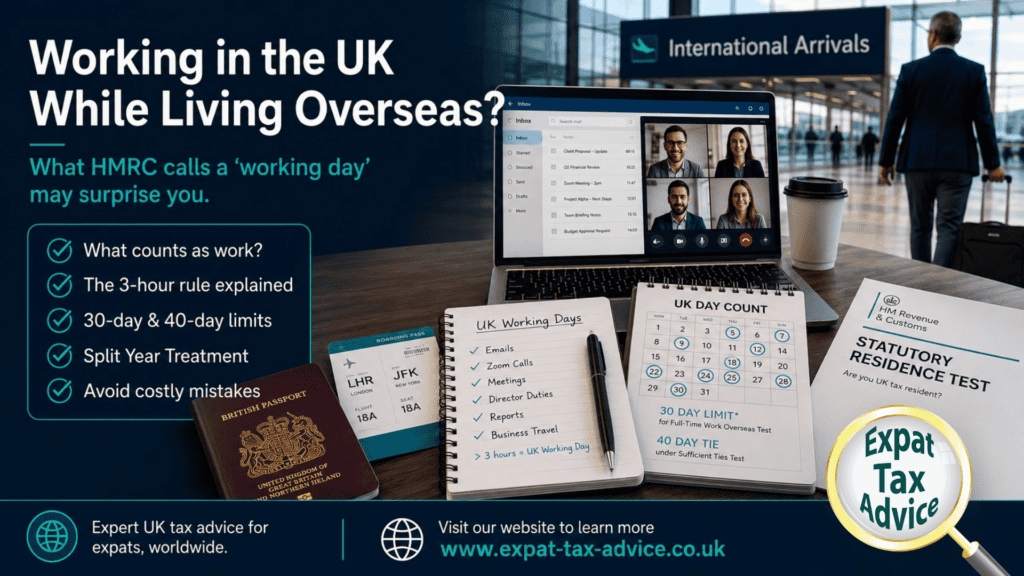
For most Statutory Residence Test purposes, a UK working day is generally a day on which more than three hours of work are performed in the UK. That work can include emails, meetings, calls, director duties, reports, work-related travel and work-related training.
3+
Hours of work can create a UK working day
30
Maximum UK workdays in key Full-Time Work Overseas cases
40
UK workdays can create a UK Work Tie
What counts as a working day under the Statutory Residence Test?
One of the most misunderstood areas of UK tax residence is the meaning of a “working day” under the Statutory Residence Test (SRT).
Many people assume that a working day means a normal office day of seven or eight hours. Others believe that answering a few emails while visiting the UK cannot possibly matter. Unfortunately, HMRC’s interpretation is far wider than most people realise.
For individuals emigrating from the UK, returning to the UK, working overseas, claiming Split Year Treatment, qualifying under the Full-Time Work Overseas Test or operating as a seafarer, consultant or digital nomad, understanding what constitutes a UK working day is essential.
Getting it wrong can mean unexpectedly becoming UK tax resident and potentially exposing worldwide income and gains to UK taxation.
Why UK working days matter
The concept of a working day appears throughout the Statutory Residence Test.
It is particularly important when considering:
- Full-Time Work Overseas
- Split Year Treatment Case 1
- Split Year Treatment Case 6
- The UK Work Tie
- The Automatic UK Full-Time Work Test
The rules use a surprisingly low threshold.
For most purposes, a day counts as a UK working day if more than three hours of work are performed in the UK during that day.
This is not three hours continuously. It is the total amount of work undertaken during that day.
What counts as work?
HMRC deliberately adopts a broad interpretation of work.
The legislation does not restrict work to paid employment.
Work can include:
Importantly, work-related travel and work-related training can also count towards the three-hour threshold.
Many internationally mobile individuals underestimate how easily three hours can accumulate.
Example: three hours can build up quickly
For example, a business owner visiting family in the UK may spend:
- One hour on emails
- One hour on a Zoom call
- Ninety minutes reviewing management accounts
That day may already have become a UK working day.
Does working from a hotel, home or holiday property count?
Yes.
HMRC is concerned with where you physically perform the work rather than where your employer or business is located.
If you are physically in the UK and carrying out work activities, the time generally counts.
This applies whether you are:
- Working from your parents’ house
- Staying in a hotel
- Using a holiday cottage
- Sitting in an airport lounge (pre-departure gate)
- Working remotely from your UK home
The location of your clients or employer is usually irrelevant.
What usually does not count as work?
Purely personal activities generally do not count.
Examples may include:
- Reading newspapers
- Managing personal investments
- Personal correspondence
- Social media use unrelated to business
- Family administration
However, caution is needed.
If investment activities become organised to the extent that they resemble a business operation, HMRC may argue that work is being undertaken.
Similarly, extensive involvement in managing your own companies may constitute work even where no salary is being received.
Do emails count as work under the SRT?
This is one of the biggest traps.
Many people believe that “just checking emails” is insignificant.
The problem is that HMRC does not ignore emails.
Reading, responding to and managing business correspondence generally constitutes work. While a handful of emails may not exceed three hours, frequent business activity throughout the day can quickly create a UK workday.
For this reason, many advisers recommend that individuals seeking non-resident status avoid conducting business activities altogether on non-work days spent in the UK.
Why company directors need to be careful
Company directors face particular challenges.
Even where no remuneration is received, carrying out director duties can constitute work.
Examples include:
- Reviewing company performance
- Approving decisions
- Attending board meetings
- Strategic planning
- Managing staff
- Reviewing contracts
Many owner-managed businesses inadvertently create UK workdays because the owner remains actively involved in management while visiting the UK.
How UK working days affect Split Year Treatment
Split Year Treatment allows a tax year to be divided into a UK resident part and a non-resident part where specific conditions are satisfied.
Several Split Year cases rely upon the Full-Time Work Overseas rules.
Where an individual leaves the UK to work abroad, they typically need to demonstrate that they are genuinely working full-time overseas.
One important condition is that UK workdays must remain below the permitted limit.
If too many UK workdays arise after departure, Split Year Treatment can fail.
The consequence can be severe because the individual may remain UK resident for the entire tax year rather than only part of it.
30
The famous 30-day rule
Many expatriates have heard of the “30-day rule”.
This comes from the Full-Time Work Overseas Test.
To qualify under the third Automatic Overseas Test, an individual must:
- Work full-time overseas
- Spend fewer than 91 days in the UK
- Work more than three hours in the UK on fewer than 31 days during the tax year
In practical terms, this means a maximum of 30 UK workdays.
The 31st day can cause the test to fail.
This is why careful record keeping is so important.
40
The 40-day UK Work Tie
A separate rule applies under the Sufficient Ties Test.
A person acquires a UK Work Tie if they work more than three hours in the UK on at least 40 days during the tax year.
This does not automatically make someone UK resident.
However, it adds one of the UK ties used to determine residence status.
For many internationally mobile individuals, accumulating an additional tie can significantly reduce the number of days they can spend in the UK without becoming resident.
Can you work in the UK without paying UK tax?
This is perhaps the most common question and unfortunately there is no single answer.
The Statutory Residence Test does not contain a rule stating that a person can work a specific number of days in the UK without paying tax.
The answer depends on:
- Whether you are UK resident
- Whether you are non-resident
- Whether a Double Taxation Agreement applies
- Whether you are employed or self-employed
- Who pays you
- Where the duties are performed
Many non-residents assume that remaining below 30 or 40 workdays means no UK tax liability.
That is incorrect.
The 30-day and 40-day thresholds relate primarily to residence testing rather than taxation itself.
A non-resident may still be taxable on earnings attributable to duties physically performed in the UK even where they spend only a handful of workdays here.
Whether relief is available will depend upon the relevant Double Taxation Agreement and the individual’s circumstances.
Practical record-keeping for SRT working days
For anyone relying on non-resident status or Split Year Treatment, good records are essential.
Keep evidence of:
HMRC can enquire into residence status many years later and the burden often falls on the taxpayer to demonstrate what happened.
Conclusion: get advice before relying on UK day-count calculations
Under the Statutory Residence Test, a UK working day is generally a day on which more than three hours of work are performed in the UK. The definition of work is much broader than many people expect and can include emails, meetings, training, business travel and director responsibilities.
The 30-day limit is particularly important for individuals relying on the Full-Time Work Overseas Test and Split Year Treatment, while 40 UK workdays can create a UK Work Tie under the Sufficient Ties Test.
Most importantly, there is no universal rule allowing a person to work a certain number of days in the UK without paying tax. Residence status and tax liability are separate issues. Even a non-resident carrying out a small amount of work in the UK may have a UK tax exposure depending upon the circumstances and any applicable tax treaty.
For anyone emigrating from the UK, returning to the UK or managing an international lifestyle, obtaining specialist advice before relying on day-count calculations can prevent costly mistakes and unexpected HMRC challenges.
Related guidance from Expat Tax Advice
These related guides may help if you are working overseas, returning to the UK or managing UK tax residence around travel days:
- Moving Abroad From the UK? Get Your Tax Right Before You Go
- What Is Split Year Treatment (SYT) and Why Is It So Important?
- SRT Deeming Rules for Expats: Why Leaving Before Midnight May Not Be Enough
- Exceptional Days in the Statutory Residence Test (SRT)
- Nomad or Seafarer? UK Tax Advice for Life Between Borders
FAQs: UK working days and the Statutory Residence Test
What is a UK working day under the Statutory Residence Test?
For most purposes, a UK working day is a day on which more than three hours of work are performed in the UK. The three hours do not need to be continuous. It is the total work carried out during that day that matters.
Do emails count as work for SRT purposes?
Reading, responding to and managing business emails generally counts as work. A small number of emails may not take you over the three-hour threshold, but repeated email activity across a day can quickly create a UK working day.
Does remote work from a UK hotel or family home count?
Yes. If you are physically in the UK and carrying out work activities, the time generally counts. This can apply whether you are working from a hotel, family home, holiday cottage, airport lounge or your own UK home.
What is the 30-day UK workday limit?
The 30-day limit is relevant to the Full-Time Work Overseas Test. To qualify under the third Automatic Overseas Test, an individual must work full-time overseas, spend fewer than 91 days in the UK and work more than three hours in the UK on fewer than 31 days during the tax year.
What is the 40-day UK Work Tie?
A person acquires a UK Work Tie if they work more than three hours in the UK on at least 40 days during the tax year. This does not automatically make someone UK resident, but it adds one of the ties used under the Sufficient Ties Test.
Can a non-resident work in the UK without paying UK tax?
There is no universal rule allowing a person to work a set number of days in the UK without paying tax. The 30-day and 40-day thresholds relate mainly to residence testing. A non-resident may still have UK tax exposure on earnings linked to duties physically performed in the UK, depending on the facts and any relevant Double Taxation Agreement.
How can UK working days affect Split Year Treatment?
Several Split Year cases rely on the Full-Time Work Overseas rules. If too many UK workdays arise after departure, Split Year Treatment can fail, which may mean the individual remains UK resident for the whole tax year rather than only part of it.
What records should I keep for UK working days?
Keep evidence of arrival and departure dates, flights, hotels, diaries, timesheets, email activity, meeting schedules and the work undertaken on each day. HMRC can ask questions years later, so clear records are important.